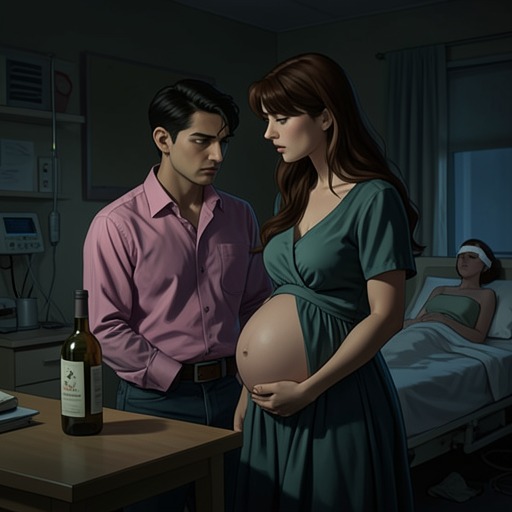
The birthday-party intoxication
The Beki CEO Got Me PregnantThe birthday-party intoxication is the prolonged drunken state surrounding Yohan's twenty-ninth birthday at the resort, where several hours of drinking culminate in Yohan kissing and later making out with Kazumi while both are too intoxicated to think clearly. Its decisive significance lies in the contrast between the party's joking atmosphere and the consequences that follow: the guests treat the night as an accidental mishap, while Kazumi must confront the possibility of pregnancy and Yohan must eventually declare responsibility for her and their child.
The Party and the Loss of Control
The intoxication develops during an evening that initially appears harmless and celebratory. After two hours of swimming and swimming games, the group begins drinking when someone calls for more alcohol. Yohan says that he does not really drink, but agrees to take shots because it is his birthday. Kazumi sits across from him, repeatedly looking at him, while he responds by acting irritated and rolling his eyes at her. The interaction already carries emotional tension, but alcohol converts that tension into a setting where ordinary restraint is repeatedly weakened.
The drinking continues for roughly four hours. By two in the morning, everyone is drunk, yet the group is still resisting sleep and continuing to drink. Headaches and physical discomfort register the body's warning, but the party proceeds instead of stopping. The intoxication is therefore not a single moment of carelessness; it is an accumulating condition produced by prolonged drinking, social pressure, and the celebratory occasion. Yohan's earlier reluctance to drink contrasts sharply with the later state in which he answers a game challenge without the judgment that would normally govern his actions.
The Dare and the Misrecognized Kiss
The immediate trigger is a drunken game of truth or dare. Yohan chooses dare, and Dennise challenges him to kiss the person sitting in front of him. Kazumi is directly opposite Yohan and is herself extremely drunk. The scene turns on a mistake of identity: Yohan believes that the person before him is Vixon, but the person he actually kisses is Kazumi. Kazumi kisses him back, changing the act from a brief imposed dare into mutual physical participation within the scene, although the surrounding evidence makes clear that both participants remain heavily impaired.
The group then decides to bring them to a bedroom because they may be dizzy. According to the later explanation of the night, Yohan and Kazumi continue kissing while being helped to the room and continue after arriving there. The others leave them because they are also drunk and assume that nothing serious will happen. The party's comic, permissive mood thus carries the pair from a public game into private isolation. The movement matters narratively: the dare creates the contact, the mistaken identity explains Yohan's initial action, and the continued kissing turns a joke into an encounter with lasting consequences.
Memory, Consent, and the Morning After
The next account of the night is fragmented and retrospective. The group remembers the truth-or-dare challenge, the mistaken belief that Kazumi was Vixon, the deepening kiss, and the continued making out in the bedroom, but no one presents a complete, reliable record of what happened there. The explanation uses the language of an unexpected drunken incident, while Kazumi recognizes that the absence of a condom may have made pregnancy possible. The difference between the group's casual reconstruction and Kazumi's immediate fear gives the state its ethical weight.
Kazumi acknowledges that she and Yohan are old enough to become parents, noting that both are twenty-nine, but she also emphasizes that the encounter was unexpected and that neither was thinking properly. She worries that Yohan is still angry with her because he has misunderstood her, and hopes that he will accept her rather than drive her away. Her fear is not limited to pregnancy itself; it concerns whether the night will produce abandonment or shared responsibility. The intoxication therefore becomes a condition of uncertain memory and unequal aftermath: the same event is treated by the witnesses as a drunken story, by Kazumi as a possible pregnancy crisis, and by Yohan as something he initially cannot process.
Yohan's reaction is immediate rejection and avoidance. He locks himself in the bedroom, saying that he cannot accept that anything happened between him and Kazumi and responding with disgust and disbelief. He is also unsure whether he used a condom. His inability to process the event shows how the party's loss of consciousness does not end when the drinking stops; it continues as denial, confusion, and an attempt to distance himself from the consequences. The narrative subsequently places responsibility against that resistance rather than allowing intoxication to erase what follows.
Responsibility and the Party's Consequences
The most consequential reversal occurs when Yohan later tells Kazumi, "Pananagutan kita." The declaration means that he will take responsibility for her, and he also tells her that she should live in his house for the time being. In this way, the intoxicated birthday night becomes linked to a concrete domestic arrangement and to a shift in Yohan's obligations. His statement does not undo the confusion or impaired condition surrounding the encounter, but it changes the direction of the aftermath from possible rejection toward material support and shared accountability.
The effects of the drunken night extend beyond the pregnancy question. Kazumi's vulnerability later becomes part of a wider conflict involving Vixon, and Yohan's protective role becomes increasingly explicit. When Kazumi is found bleeding, a doctor gives Yohan medication for her injuries and vitamins for the baby, while urging him to dismiss Vixon and prevent Kazumi from moving around too much. The party is therefore not an isolated romantic episode: it establishes the pregnancy that makes Kazumi physically vulnerable, gives Yohan a reason to assume a caregiving role, and intensifies the power struggles around them.
Yohan's later defense of Kazumi also shows how responsibility becomes a public and institutional matter. He condemns Xan for speaking about Kazumi in a degrading way and accuses him of pretending to be kind only to use and discard her. His anger links the private promise made after the birthday incident to a broader demand that Kazumi be treated as someone worthy of protection rather than as an object of ridicule or exploitation. The story consequently moves from intoxicated intimacy to disputes over employment, loyalty, violence, and authority.
Narrative Function and Significance
As a state, the birthday-party intoxication is the story's threshold between friendship, hostility, and unintended intimacy. The drinking temporarily suspends the social identities that ordinarily organize the group: Yohan mistakes Kazumi for Vixon, a dare substitutes for deliberate decision, and the friends' supervision gives way to a careless assumption that nothing can go wrong. The resulting disorder is short-lived, but its consequences are durable. Alcohol opens the boundary between Yohan and Kazumi, while the pregnancy forces the characters to rebuild boundaries through residence, responsibility, protection, and eventually relationship.
The episode also exposes the instability of responsibility in a narrative that treats the night as both comic accident and serious turning point. The repeated joking tone, the late-hour drinking, and the group's willingness to leave the pair alone create a carnival-like suspension of ordinary rules. Yet the consequences are not playful: Kazumi fears abandonment, Yohan retreats in disgust, and later medical and legal dangers surround their household. The contrast gives the intoxication its structural force. It is not merely background to the romance; it is the impaired condition that makes the romance possible while making consent, memory, and accountability difficult to separate.
The state ultimately persists in memory even after sobriety returns. The party's details are reconstructed through partial recollections, while Yohan's denial and Kazumi's anxiety reveal different ways of living with the same night. Later declarations of responsibility, demands that Vixon be fired, police involvement, and the report that Vixon tried to kill Kazumi all show how far the consequences travel from the original birthday celebration. The drunkenness ends within hours, but its narrative afterlife governs the characters' domestic arrangements, conflicts, and obligations long afterward.